


National Education Registry

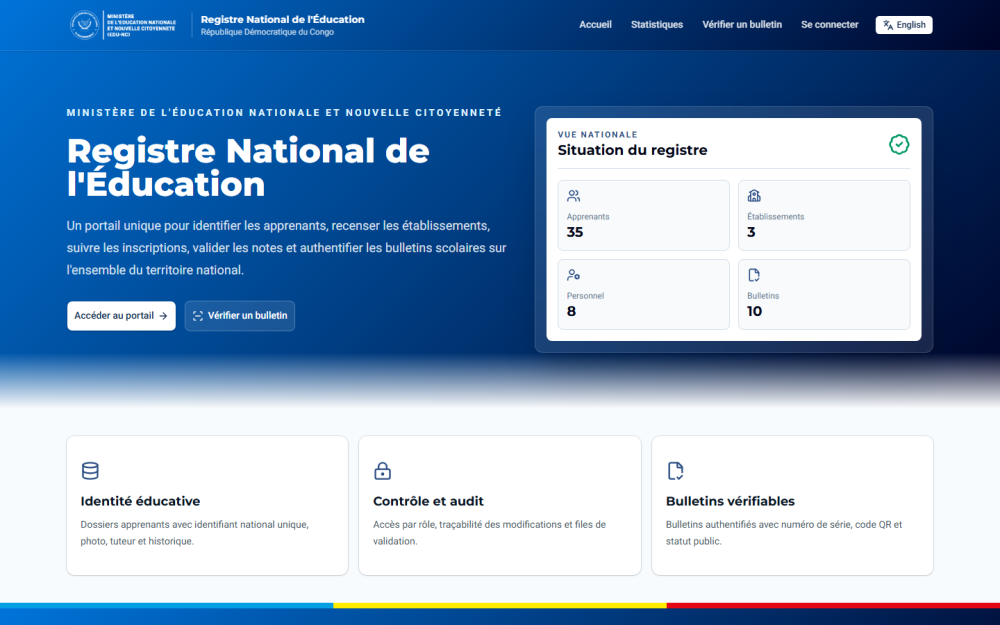
One identifier per learner, a report card anyone can verify
A single portal to identify learners, register schools, track enrolments, validate grades and authenticate school reports at national scale.
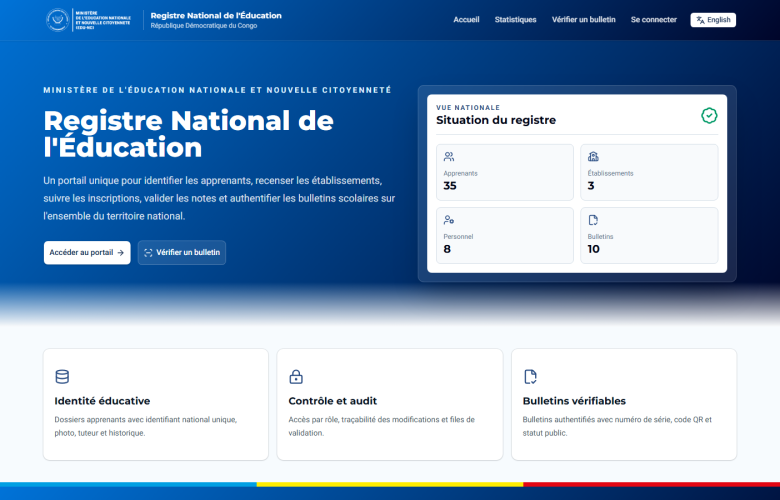
At national scale the question is no longer “how many pupils do we have?” but “can we prove it?”. The National Education Registry was built for exactly that.
Four functions
- Educational identity — a centralised profile for every learner: unique national identifier, photograph, guardians, full academic history.
- School registry — a national directory of schools and enrolment tracking across the territory.
- Verifiable reports — every report card carries a serial number and QR code allowing immediate public verification, with no account and no paperwork.
- Control and audit — role-based access, full traceability of changes, grade validation workflows.
A national view
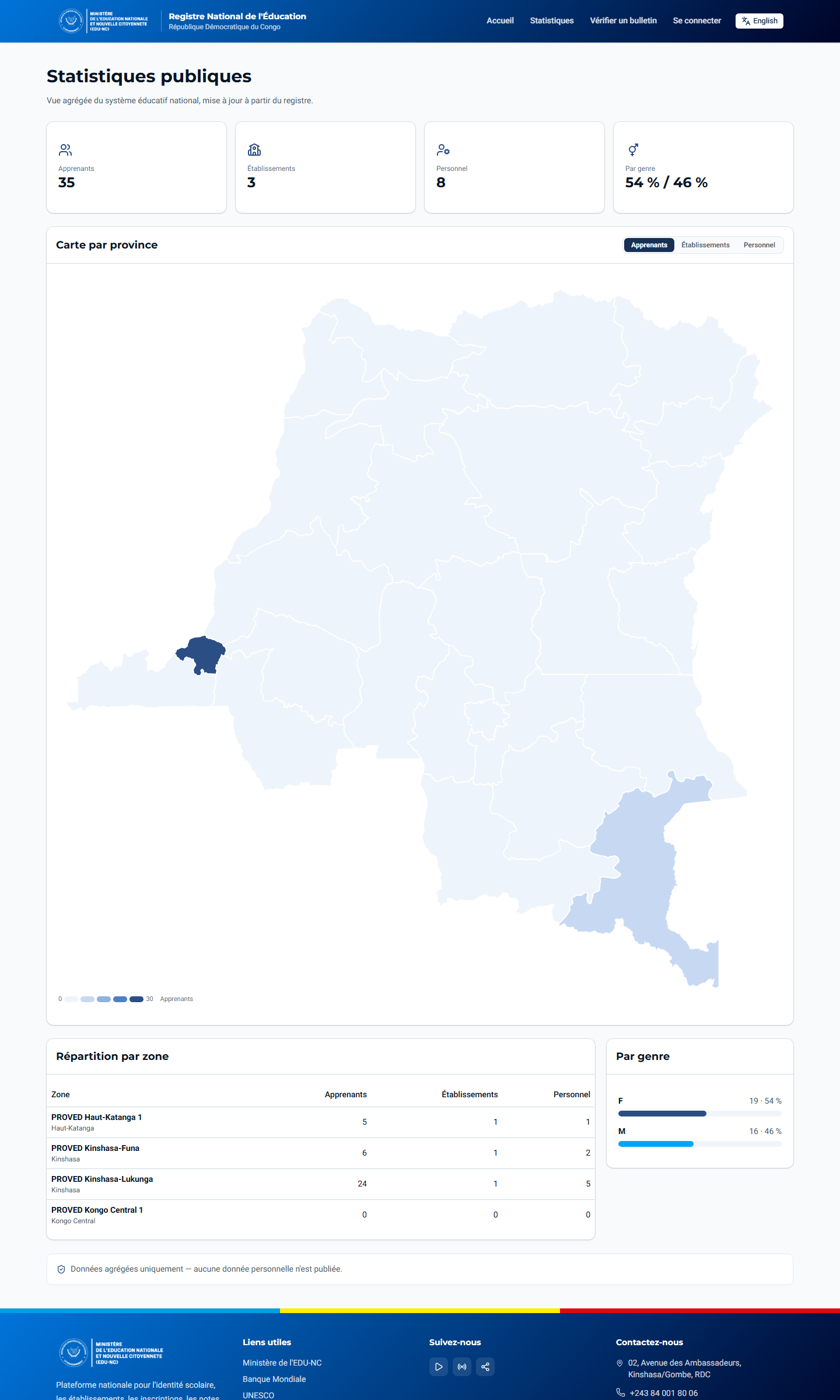
The dashboard aggregates the state of the registry: learners, schools, staff and issued reports, with statistics per territory.
Who it is for
Education ministries and departments, inspectorates, certification agencies — wherever the reliability of a diploma underpins trust in the whole education system.
Verifying a report card in public
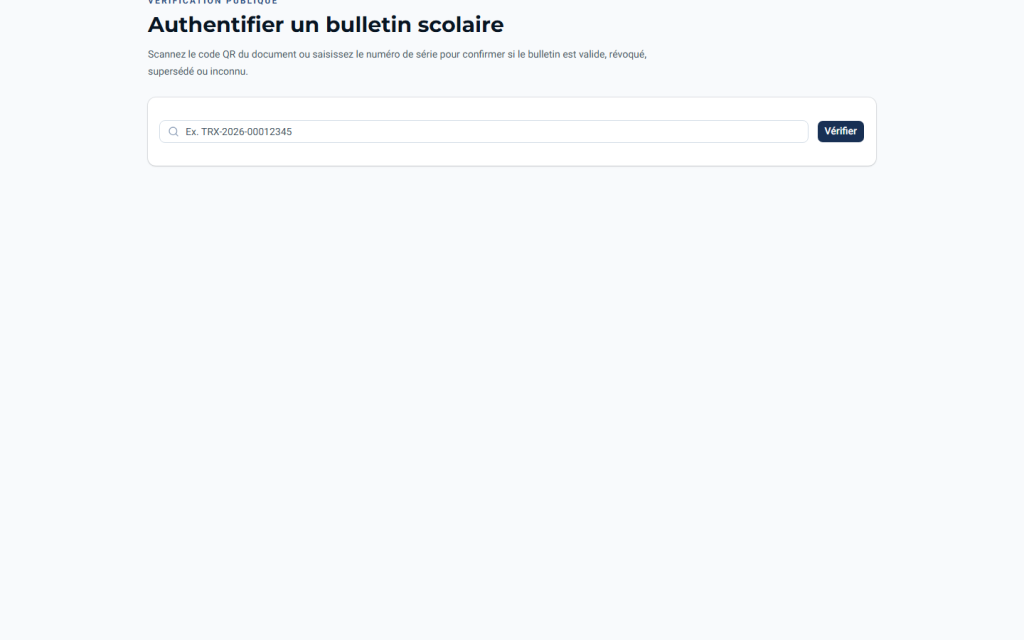
Every report card issued carries a serial number and a QR code. Anyone — an employer, a university, an embassy — scans the document or types the number and immediately gets one of four statuses: valid, revoked, superseded by a newer version, or unknown. No account, no procedure, no delay.
That is the whole point of a national registry: a forged certificate stops being a design problem and becomes a problem of existing in the database.
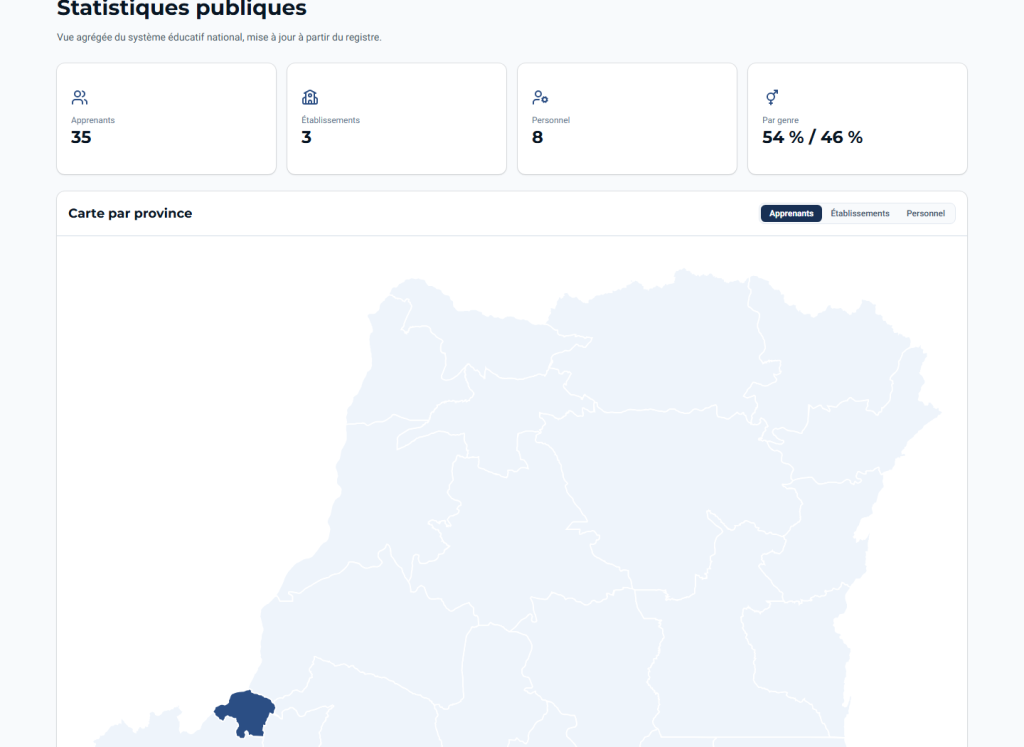
Public statistics, no personal data
The portal publishes an aggregated view of the education system: numbers of learners, schools and staff, gender split, a province map and a breakdown by administrative zone (PROVED). The principle is explicit and displayed on the site: aggregated data only, no personal data published.
A ministry can therefore show its figures without exposing a single pupil, and technical partners finally have one source instead of four tables that contradict each other.
What a national rollout really requires
- A unique identifier — a learner keeps the same number from one school to the next, from one province to another.
- Role-based access — head teacher, inspector, provincial service, central administration: each sees their own scope and nothing else.
- Validation queues — a grade only enters the registry after the intended approval route.
- Traceability — every change is time-stamped and attributed. A registry without an audit trail is not a registry.
- Bilingual — French and English, for exchanges with international partners.
Have a national or regional project in mind? Let’s talk: we know what this kind of deployment really demands.
Let’s talk about your project. The first call is on us.
30 minutes to understand your need, tell you whether one of our platforms already answers it, and if not, estimate what a custom build would cost.