



Ravito

The order and its delivery in a single application
The customer orders, the driver delivers, operations coordinate, administration configures. Four portals, one thread: from the order placed to the crate delivered and the empties collected.
Between the beverage depot and the bar restocking its fridge, everything still happens by phone: an order scribbled in a notebook, a truck you call to find out where it is, cash counted at night, empty crates nobody remembers to claim. Ravito ties those four moments into one application.
Four portals, one journey
- Customer — orders drinks, pays and follows deliveries.
- Driver — follows the route and records what was actually delivered.
- Operations — confirms orders, loads trucks, organises delivery sessions.
- Administration — manages access, the catalogue and the reference data.
The life of an order
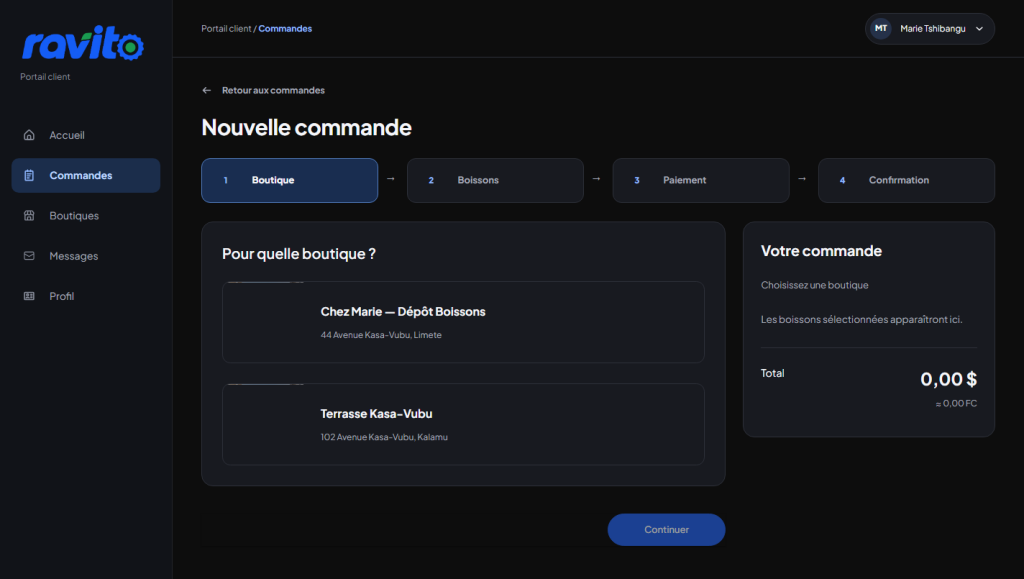
- Order — the customer picks a shop, the drinks and a payment method in four steps; the basket and total update as they go.
- Confirmation — operations confirm or cancel, with a confirmation prompt every time.
- Delivery — a session ties a truck, a driver and the loaded orders together, within the crate capacity.
- Result — the driver records quantities delivered, cash taken and empties collected. The order becomes complete, partial, failed or cancelled.
For the customer
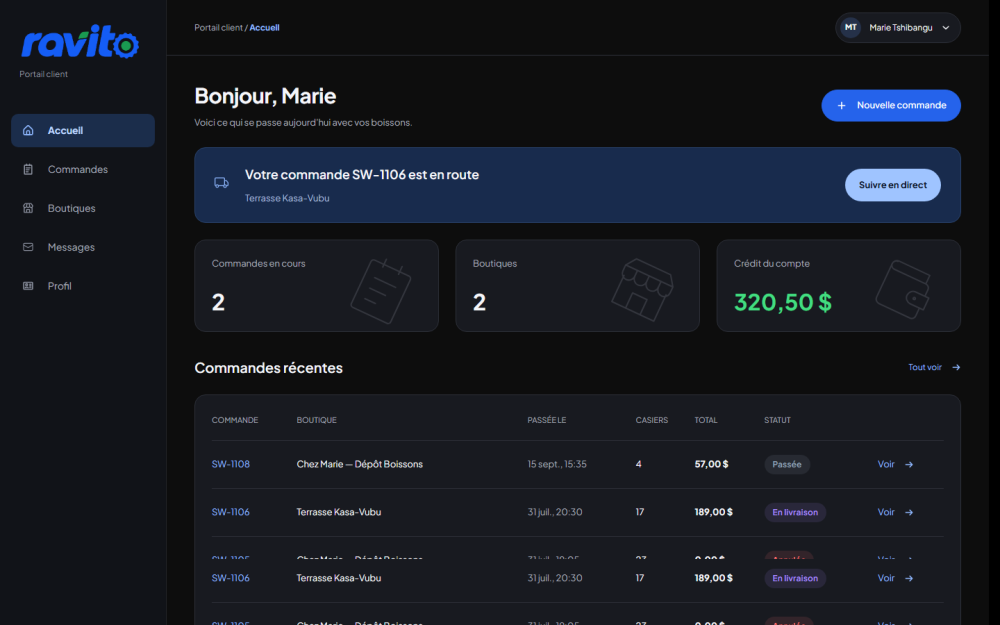
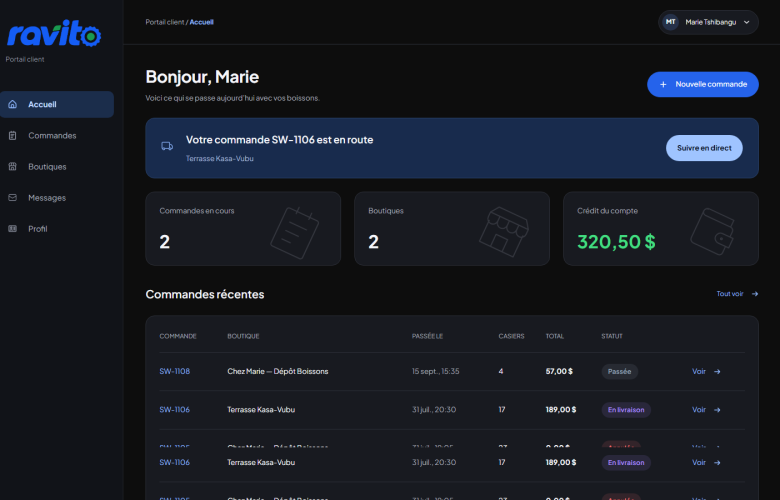
The home screen shows what matters: the order on its way with live tracking, the shops, the account credit and recent orders. Each shop has its own record — address, contact, photo, adjustable position on the map — and keeps its history even once it is no longer active.
Payment is chosen at ordering time: Mobile Money with operator selection, or cash on delivery, with the total converted into Congolese francs. After delivery the amount due is recalculated on what was actually received; an overpayment becomes account credit, visible and carried to the next order.
Customers can amend or cancel until the order is confirmed, follow the truck on the map, then rate punctuality, the driver, the condition of the goods and whether the delivery matched the order.
For the driver
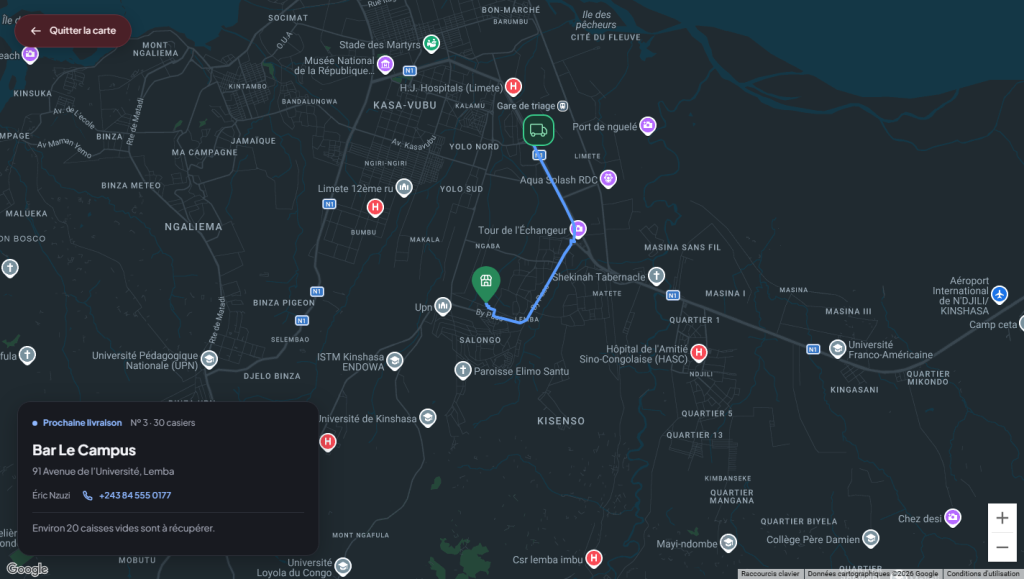
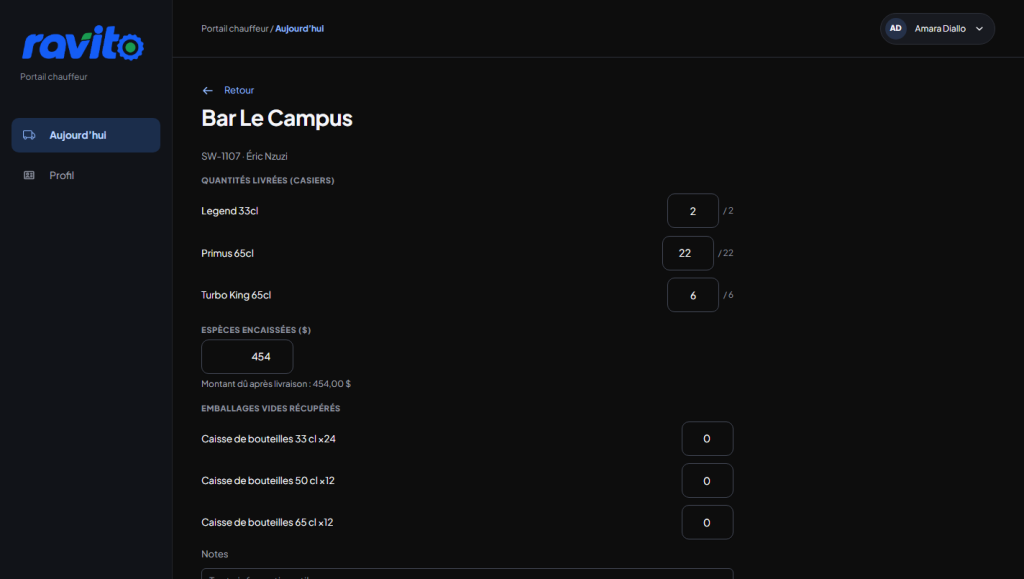
A single screen, built for the field: the next stop first — shop, contact, instructions, crates to drop, cash to collect — then the list of stops and their progress, reorderable by hand. An immersive map shows the truck’s position and the route to the next stop, with the delivery record still at hand.
At each stop the driver records quantities delivered product by product, cash received, empties collected by type, and a note. Nothing is assumed: what is recorded is what happened.
For operations
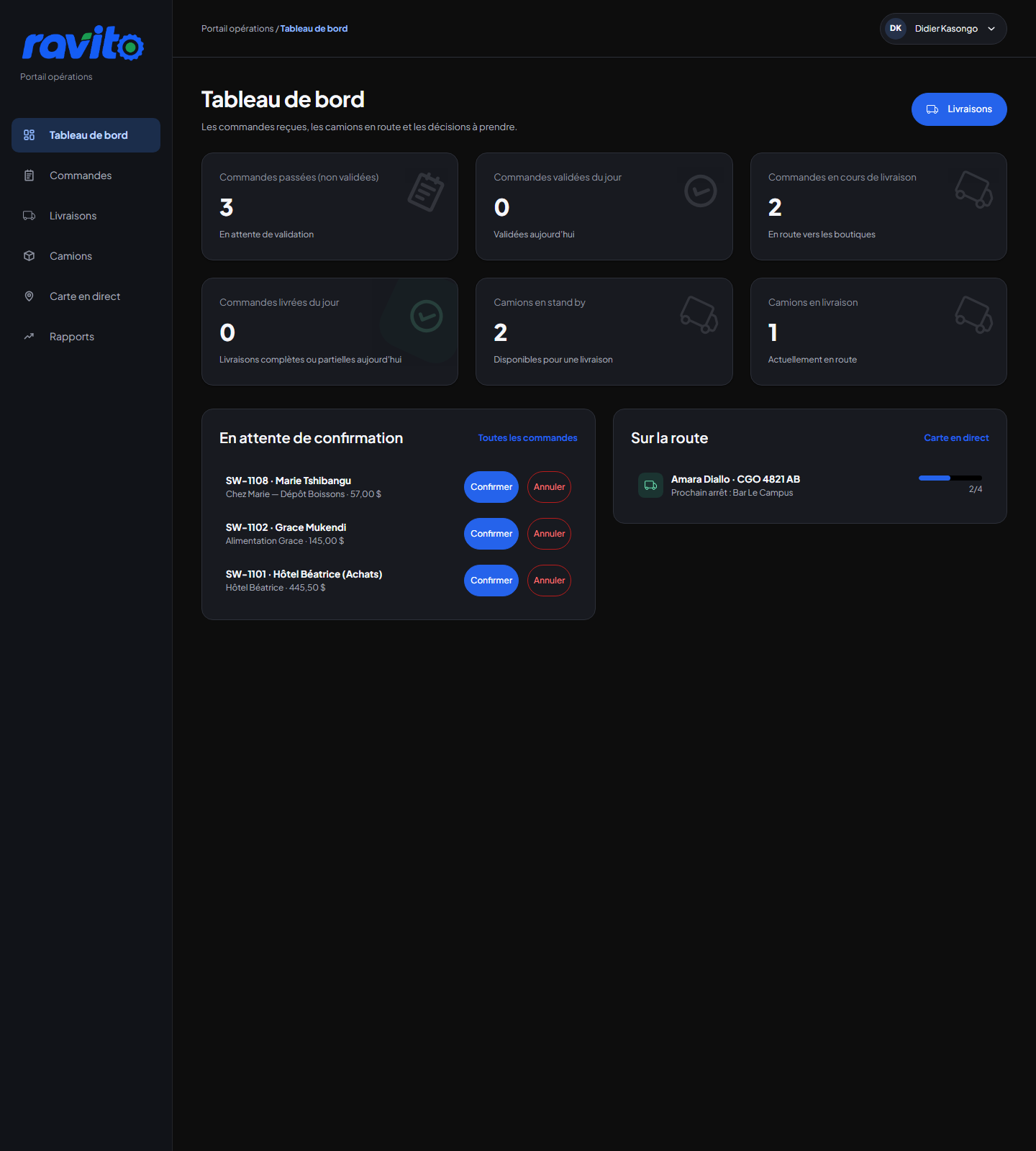
Six indicators each open their own list: orders awaiting confirmation, confirmed today, out for delivery, delivered today, trucks on stand-by and trucks on the road. Orders to confirm stay one click away from the dashboard.
Every case file gathers the products ordered and delivered, the amounts ordered, due, paid and outstanding, the status and payment history, the truck, the driver and a link to the delivery in progress. The fleet has a record per truck — plate, make, model, year, colour, depot, crate capacity, tracker and last known position — and a shared map for following several trucks at once.
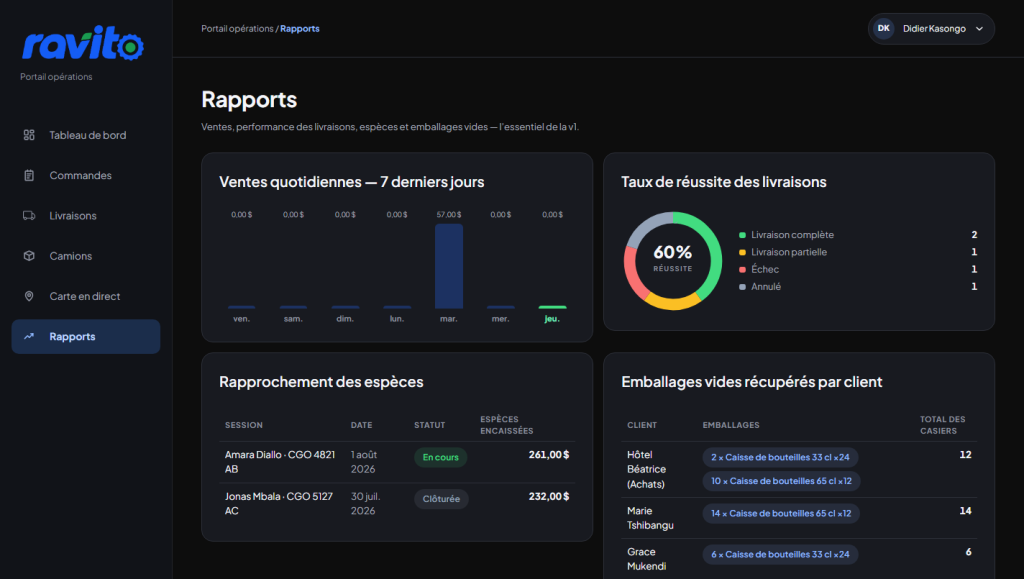
Four reports close the loop: sales over the last seven days, breakdown of delivery outcomes and success rate, cash reconciliation per session with driver and truck, and empties collected by customer and by type.
For administration
Accounts and roles, activation and deactivation. One catalogue shared by all customers: SKU, brand, category, volume, units per crate, price per crate, returnable packaging, photo, withdrawal and return to sale. And the shared reference data: currencies and dated exchange rates, Mobile Money operators, returnable packaging types, depots with address and GPS coordinates.
Who is it for?
Beverage depots and distributors, breweries and their networks, wholesalers delivering bars, restaurants, hotels and grocery shops. Anywhere goods are sold by the crate, cash matters as much as Mobile Money, and returnable packaging is part of the trade.
Visit all four portals without installing anything. A “demo account” button opens the application with sample data: order as a customer, deliver as a driver, confirm as operations. Then let’s talk about your network.

Let’s talk about your project. The first call is on us.
30 minutes to understand your need, tell you whether one of our platforms already answers it, and if not, estimate what a custom build would cost.